LLM Integration
Large Language Model integration design
LLM Integration
Strategy and design for integrating Large Language Models with OctoMY™ safely and effectively.
Did You Know?
OctoMY™'s LLM strategy is "local-first" - your robot can run AI on its own hardware (via llama.cpp or similar) without ever contacting the internet. External LLMs like Claude are only accessed through a Hub, which acts as a single security gateway. This means your robot keeps working even without internet.
Topics
| Topic | Description |
|---|---|
| Strategy | Overall approach to LLM integration |
| OPAL design | Operator Permission and Access Layer |
| Event flow | How LLM interactions are processed |
Overview
In 2025, ignoring LLMs is not an option. OctoMY™ integrates AI constructively while maintaining safety through:
- Embedded/Strategic Barrier - Clear boundary between real-time control and high-level planning
- Trust-based Permissions - LLM actions bounded by operator-granted permissions
- Auditable Commands - All LLM actions logged and reversible
Key concepts
The safety model
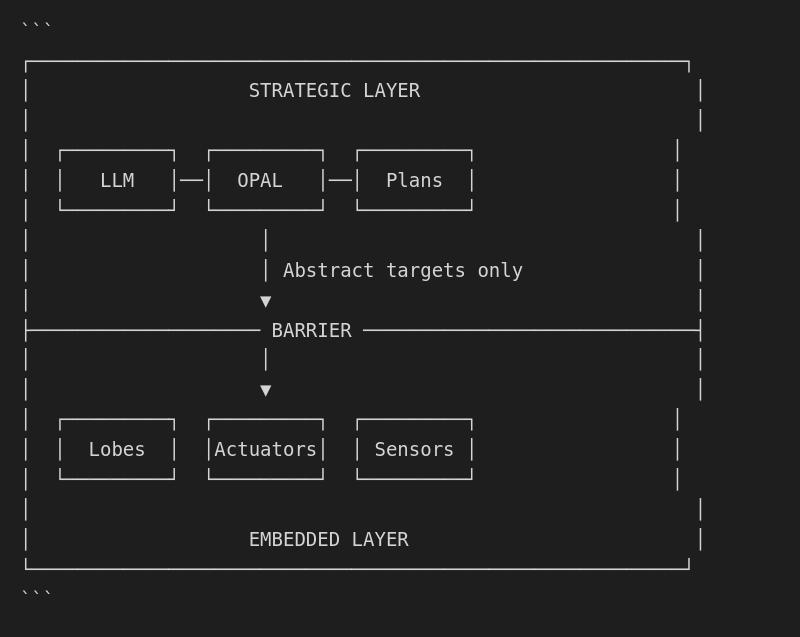
LLMs operate in the strategic layer with full creative freedom, but can only affect hardware through abstract targets that the embedded layer translates safely.
OPAL: the control layer
OPAL (Operator Permission and Access Layer) enables safe LLM control:
- Structured commands - JSON API, not free-form text
- Permission system - Granular, user-controlled access
- Self-documenting - LLMs can discover available commands
- Audit logging - Every action is recorded
Local-first AI
OctoMY™ prioritizes local LLM execution:
- Agents can run local LLMs (llama.cpp, etc.)
- No internet required for basic AI features
- External LLMs accessed only through Hub
- Privacy and latency benefits