LLM Strategy
Overall approach to LLM integration
LLM Strategy
OctoMY™'s approach to integrating Large Language Models safely and effectively.
Did You Know?
OctoMY™'s LLM strategy was designed with a specific threat model in mind: "what if the AI hallucinates and tries to drive the robot off a cliff?" The answer is the embedded/strategic barrier - even if the AI generates a perfect-sounding command to "maximize velocity toward coordinates (cliff)", the embedded layer's safety monitors will refuse to execute it.
Context
In 2025, ignoring LLMs is not an option. OctoMY™ integrates modern AI technology constructively across:
- Development tooling - Accelerating the development process
- Runtime features - User-facing AI capabilities
- Server-side services - Backend AI integration
Target users
| Priority | Audience | Benefit |
|---|---|---|
| Primary | Hobby robotics community | Accessible AI-powered robots |
| Secondary | Expert roboticists | Sophisticated tooling |
| Immediate | OctoMY™ developers | LLM-accelerated development |
Core principles
1. Local-first
All node-side LLM runs locally. No internet contact except via Zoo (hole-punching) or Hub.
Agent with local LLM
    │
    ├─► Local inference (no internet)
    │
    └─► Hub connection (if external LLM needed)
            │
            └─► External API (Claude, etc.)
Why: Privacy, latency, offline operation, reduced attack surface.
2. Hub as gateway
External services (LLMs, APIs, models) are accessed only through a trusted Hub node.
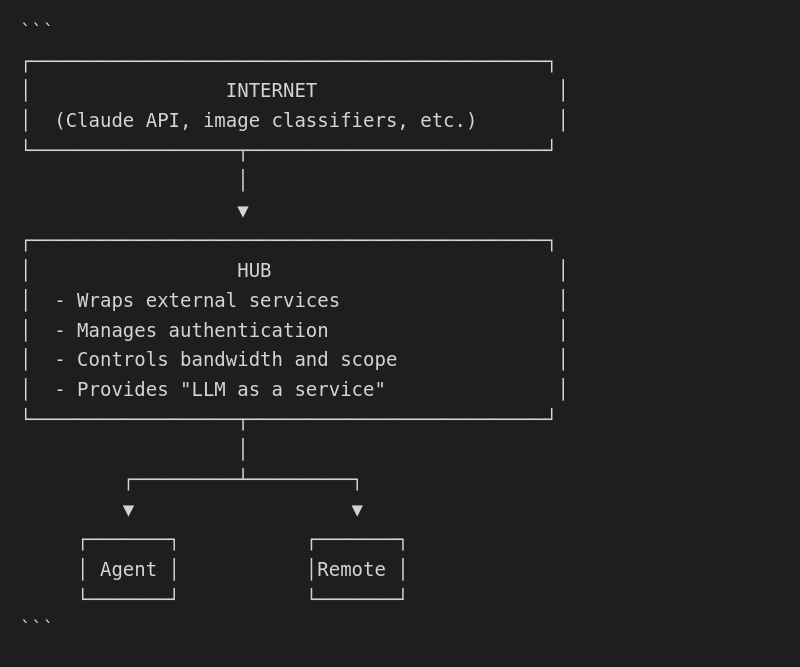
Why: Single security boundary, centralized access control, simplified node requirements.
3. Permission-centric
LLMs operate within explicit, user-granted permissions via OPAL (Operator Permission and Access Layer).
Why: Human authority over AI actions, auditability, safety.
4. Deterministic identity
Agent personalities are RNG-derived from cryptographic keys, ensuring consistency across contexts.
Why: Recognizable robot identity, consistent interaction experience.
The embedded/strategic barrier
OctoMY™ enforces strict separation between hardware control and AI:
| Layer | Characteristics | LLM Access |
|---|---|---|
| Embedded | Real-time, deterministic, safety-critical | None |
| Strategic | Flexible, creative, latency-tolerant | Full (with permissions) |
LLMs can request "navigate to kitchen" but cannot command "set motor voltage to 12V".
See Embedded/Strategic Barrier for details.
Implementation phases
Phase 1: Development acceleration
Shorten the LLM-fueled development feedback loop.
Components:
- uiautomation - Tool for UI testing and screenshot capture
- mocknode - Standardized test harness mimicking any node type
- Documentation generation - Automated screenshot capture
Value: Benefits developers immediately. LLM can invoke tools directly, creating closed feedback loops.
Phase 2: Automated testing
Maintain quality as development accelerates.
Components:
- uitest - Extends uiautomation for regression testing
- Visual regression - Screenshot comparison
- LLM-aided test authoring - Beyond unit tests
Value: While Phase 1 lives in the moment, Phase 2 secures the legacy.
Phase 3: OPAL runtime layer
Enable LLM-driven agent management with proper access control.
Components:
- Permission system
- Command API (structured JSON)
- Self-documenting endpoints
- User consent UI
Value: Safe, auditable LLM control of robots.
Phase 4: Convenience features
User-facing LLM helpers that depend on OPAL.
Components:
- Autocomplete/suggestions
- Natural language commands
- Personality-driven interactions
Value: Accessible AI for end users.
LLM deployment options
Local LLM (agent)
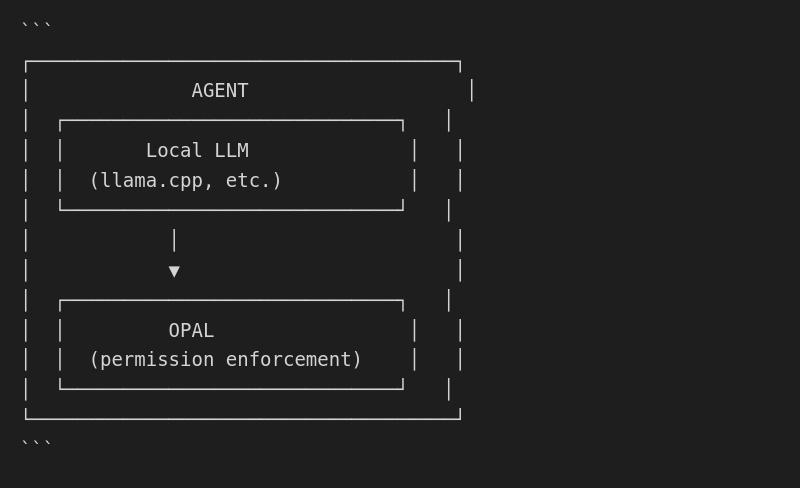
- Runs on agent hardware
- No network required
- Limited by hardware capabilities
- Full privacy
External LLM (via hub)
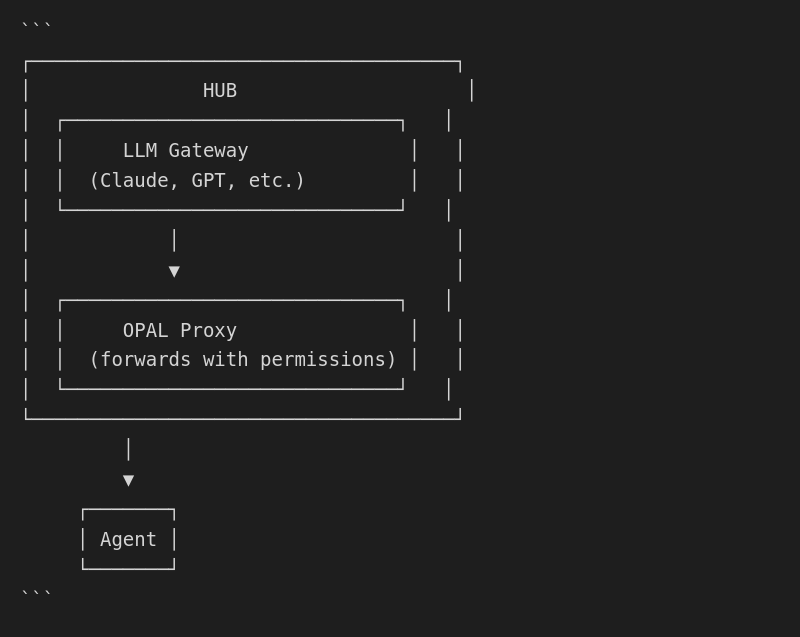
- Powerful models available
- Requires Hub and internet
- Hub manages API keys
- Permissions still enforced
Personality and LLM
When LLMs interact through an agent, personality provides consistency:
Agent Key → Deterministic RNG → Personality Traits
                               ├── Name
                               ├── Voice characteristics
                               ├── Visual identity
                               └── LLM persona prompt
The personality generates a prompt fragment:
You are [Name], a [traits] robot assistant.
You speak with [voice characteristics].
Your responses should reflect [personality aspects].
This ensures the same robot has a consistent identity regardless of which LLM backend is used.