Couriers and Sessions
Communication patterns in OctoMY™
Couriers and Sessions
How OctoMY™ nodes communicate through typed message handlers (Couriers) over secure connections (Sessions).
Did You Know?
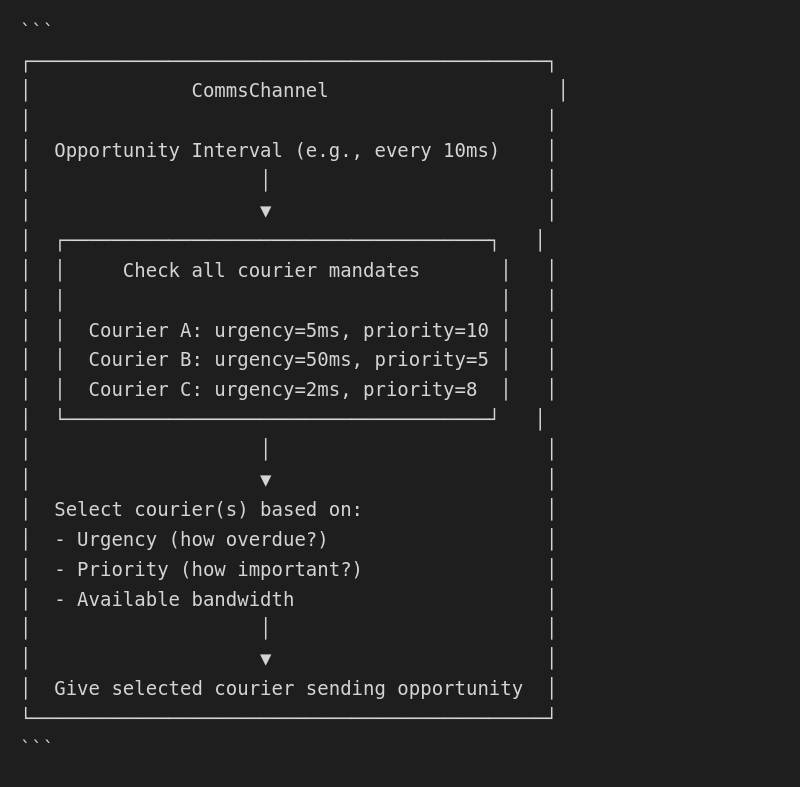
The courier system is inspired by medieval postal services - each courier has a "mandate" specifying urgency and priority. CommsChannel acts as the postmaster, deciding which couriers get to send based on their mandates and available bandwidth. High-urgency couriers (like real-time control) get priority over low-urgency ones (like file transfers).
Overview
OctoMY™ communication uses two key concepts:
| Concept | Purpose |
|---|---|
| Session | Secure, authenticated connection between two nodes |
| Courier | Typed message handler for specific data types |
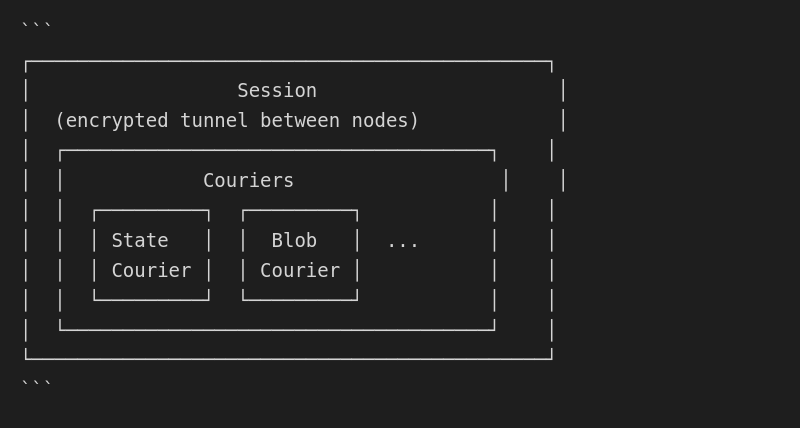
Sessions
A Session is an active, secure communication channel between two nodes.
Session lifecycle
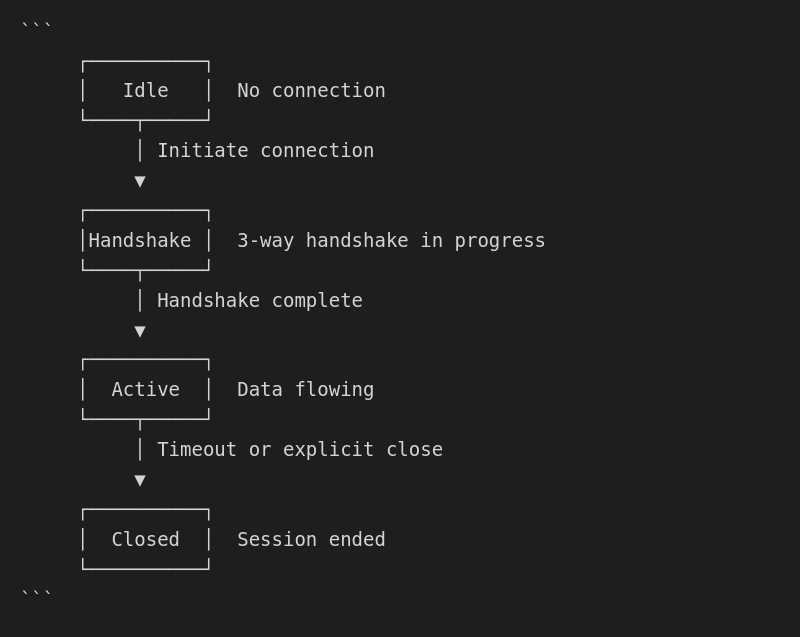
Session properties
| Property | Description |
|---|---|
| Session ID | Unique identifier for this session |
| Participants | The two nodes involved |
| State | Current lifecycle state |
| Last Activity | Timestamp of last packet |
| Security | Encryption keys, nonces |
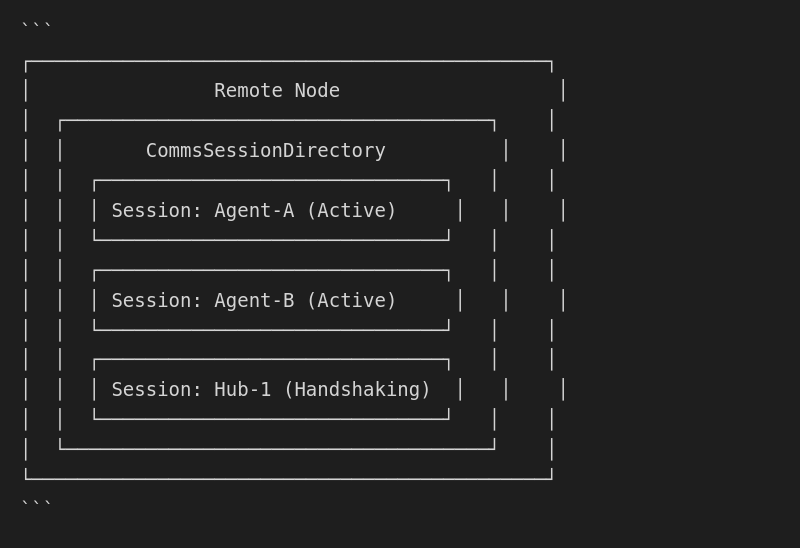
Multiple sessions
A node can have multiple active sessions simultaneously:
Couriers
Couriers are typed message handlers that manage specific kinds of data within a session.
What couriers do
- Maintain state - Keep latest data ready to send
- Handle priorities - Express urgency and importance
- Process incoming - React to received messages
- Generate outgoing - Produce messages when given opportunity
The courier interface
Each Courier exposes a CourierMandate describing its needs:
struct CourierMandate {
    int urgency;        // ms until next send desired
    int priority;       // 0-255, lower = lower priority
    bool acceptReads;   // accept incoming data?
    bool wantToSend;    // have outgoing data?
    int payloadSize;    // expected bytes to send
};
Common couriers
| Courier | Purpose | Priority | Frequency |
|---|---|---|---|
| AgentStateCourier | Main state sync | High | Continuous |
| BlobCourier | File transfer | Low | On demand |
| SensorsCourier | Sensor data | Medium | Rapid |
| DiscoveryCourier | Discovery messages | Medium | Occasional |
AgentStateCourier
The primary courier for robot state synchronization.
Responsibilities
- Expose current agent state (position, battery, status)
- Accept state updates from controllers
- Maintain "verified" flag for each parameter
- Answer freshness queries ("how old is this data?")
Idle packets
AgentStateCourier sends idle packets even when nothing changes:
- Confirms data is still current
- Maintains connection liveness
- Allows rapid detection of disconnection
BlobCourier
Handles large data transfers that don't fit in single packets.
Features
- Chunking - Splits large data into packets
- Reassembly - Reconstructs at destination
- Reliability - Retransmits lost chunks
- Progress - Reports transfer progress
Use cases
- Firmware updates
- Log file transfers
- Configuration files
- Captured images
How couriers are scheduled
CommsChannel manages all registered couriers:
Courier sets
Couriers are grouped into CourierSets for convenience:
AgentCourierSet
Default couriers for Agent nodes:
- AgentStateCourier
- SensorsCourier
- BlobCourier
RemoteCourierSet
Default couriers for Remote nodes:
- RemoteStateCourier
- CommandCourier
- BlobCourier
Dynamic registration
Couriers can be added/removed dynamically:
- When connecting to new nodes
- When enabling/disabling features
- When changing operational mode
Session vs courier multiplexing
Single session, multiple couriers
One session can carry many courier types:
Session A ──┬── AgentStateCourier
            ├── SensorsCourier
            ├── BlobCourier
            └── CommandCourier
Multiple sessions, Same Courier Types
A Remote controlling multiple Agents:
Remote
  ├── Session to Agent-A
  │     ├── AgentStateCourier (for A)
  │     └── SensorsCourier (for A)
  │
  └── Session to Agent-B
        ├── AgentStateCourier (for B)
        └── SensorsCourier (for B)
Connection modes
CommsChannel operates in different modes:
Normal mode
- Pings inactive nodes at exponentially decaying rate
- Maintains active sessions
- Balances bandwidth across couriers
Honeymoon mode
- Enabled after connection enabled
- Pings all known nodes frequently
- Quickly establishes sessions
- Automatically expires
Celibacy mode
- After explicit disconnection
- Node receives no pings for grace period
- Prevents unwanted reconnection