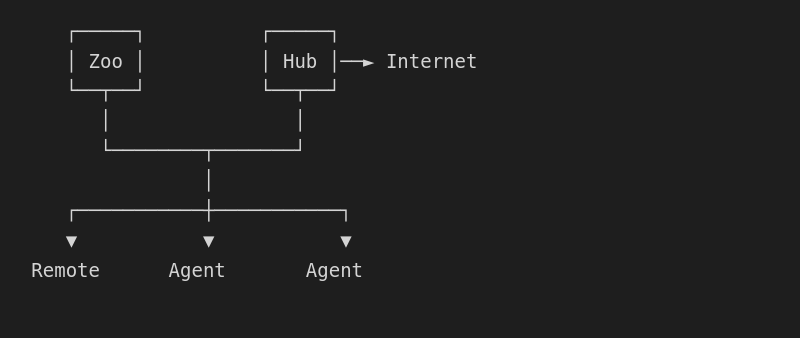
Node Types
Agent, Remote, Hub, and Zoo
Node Types
The four types of nodes in the OctoMY™ network, each serving a distinct role.
Did You Know?
The term "Agent" was chosen instead of "robot" because OctoMY™ can control anything with actuators and sensors - not just physical robots. A smart home device, an animatronic prop, or even a virtual character could all be Agents.
Agent
The Agent represents a robot or autonomous device. It is called an "Agent" rather than "robot" because the term is more general and doesn't impose assumptions about physical form.
Characteristics
- Runs on the robot hardware itself
- Controls actuators (motors, servos, etc.)
- Reads sensors (cameras, distance, orientation)
- Executes Plans for autonomous behavior
- Can run a local LLM for on-device intelligence
Typical hardware
- Android phone attached to a robot chassis
- Raspberry Pi with motor controllers
- Arduino with communication shield
- Custom embedded system
Examples
- RC car with Arduino + Android combo
- Hexapod walking robot
- Quadcopter drone
- Virtual robot in a simulation
Remote
The Remote represents the user interface for controlling Agents. It allows both human operators and automated systems to provide input.
Characteristics
- Thin client focused on user interface
- Displays real-time status from Agents
- Sends commands to paired Agents
- Adapts UI dynamically based on Agent capabilities
- Can control multiple Agents simultaneously
Input modes
Remotes support various levels of control:
- Low-level: Direct actuator manipulation in real-time
- Mid-level: Preset movements and gestures
- High-level: Target points on maps, natural language commands
Typical hardware
- Smartphone or tablet
- Desktop computer
- Dedicated control station
Hub
The Hub is a coordination node designed for stationary, high-performance hardware. It serves as the bridge between the local OctoMY™ network and external services.
Characteristics
- Runs on server or workstation hardware
- Never runs on mobile devices
- Gateway to internet services
- Coordinates multi-Agent operations
- Provides "LLM as a service" to Agents
Responsibilities
- Data aggregation: Collects data from all connected Agents
- Heavy processing: Runs compute-intensive tasks (AI inference, path planning)
- External integration: Connects to cloud APIs, external LLMs
- Fleet coordination: Manages collaboration between multiple Agents
- Persistent storage: Long-term data archival
Key principle
Agents and Remotes never contact the internet directly. All external communication goes through a Hub, creating a single point of security control.
Zoo
The Zoo is OctoMY™'s discovery and connectivity service. It helps nodes find each other across network boundaries.
Characteristics
- Runs as a cloud service
- Minimal functionality for security
- No access to user data
- Facilitates NAT traversal
Services
- UDP hole-punching: Helps nodes connect through firewalls
- Discovery coordination: Helps nodes find each other by GPS proximity
- Connectivity relay: Last resort when direct connection fails
Security design
The Zoo is designed to know as little as possible:
- No access to message contents
- No persistent storage of user data
- Minimal attack surface
Node comparison
| Aspect | Agent | Remote | Hub | Zoo |
|---|---|---|---|---|
| Hardware | Robot/embedded | Phone/desktop | Server | Cloud |
| Internet access | Via Hub only | Via Hub only | Yes | Yes |
| Controls actuators | Yes | No | No | No |
| User interface | Minimal | Primary | Admin | None |
| LLM capability | Local | None | External | None |
| Required? | Yes | Yes | Optional | Optional |
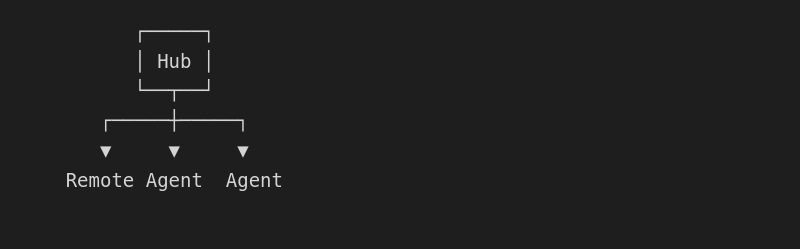
Network topology
A minimal OctoMY™ setup requires only an Agent and a Remote. Additional nodes add capabilities:
Minimal setup

With Hub
Full network